Compared to some other brands of similar price, the Skullcandy Ink’d 2.0 Wired Earbuds have deeper, fuller bass and superior detail/definition. They also fit and stay in your ears better than the Sonys did (I wear them when exercising). The flat cord still tangles sometimes, but not as often or severely as the round ones seem to. Another thing that’s worth mentioning is that if you break them, Skullcandy will give you a coupon for half of the MSRP value that can be used toward a purchase on their website.
There was a time in our innocent past when people trusted and preferred stories where the hero and villain were clearly defined, the simple math being that the good guy always did the right thing while the bad guy did what felt good no matter what or who got hurt. But after centuries of righteous humans killing and raping in the name of their gods, and the more recent revelations that every cop is a criminal and all the sinners saints (sho’ nuff, Mick!) it became apparent that the traditional storytelling model was suspect (as well as fucking boring).
Right around the time Lucifer — er, Mick Jagger made that declaration, Hollywood and popular culture in general began to champion the idea of the antihero. Suddenly you had Warren Beatty raising holy hell as Clyde Barrow with chic, smokin’ Faye Dunaway as Bonnie Parker at his side. Audiences were now put in the position of rooting for the not-so-good guys, and Hollywood no longer made any pretense about not glorifying the sinners — just so long as the sinners were sexy. Hell, if Bonnie and Clyde had been purely fictional cinema creations and not real people, they might have even avoided being turned into bloody, bullet-riddled sacks of sexy flesh at the end!
Wholesome American heroism
The point is, with the rise of the likes of Cool Hand Luke, Butch and Sundance, Michael Corleone, and Ratso Rizzo, coupled with the moral uncertainties caused by the assassinations of the Sixties, the political and moral ambiguities of Vietnam, and the civic betrayals of Watergate, antiquated notions of noble heroism were no longer satisfactory for anyone above the age of 14.
Which brings us all the way to 2013 and the case of Walter White, a.k.a., Heisenberg, a.k.a. the most complex antihero character in the history of the big OR small screen, BIITCCHH!!! (sho’ nuff, Jesse!). Notice I did not say the best antihero. The reason for this is that Tony Soprano was, in many ways, the apex in the evolution of the antihero, and without him Walter White would arguably be a dead, un-ejaculated sperm in the dick that was the gleam in the eye of Vince Gilligan’s creative imagination. Still, Walt was a more complex animal.
So, without further ado, here are 6 reasons why:
6. UNLIKE TONY, WALT HAD NO ALPHA-MALE SOCIOPATH EXAMPLES FROM HIS CHILDHOOD
As any fan of The Sopranos is well aware, Tony didn’t exactly grow up in a Ward and June Cleaver-style household. Who in any recognizable realm of fucking reality has though, right? But allowing for the possibility that such ideal domesticity exists at all, the average family would fall somewhere on the spectrum between — and hopefully much closer to –the Cleavers, and the sublime mindfuckery that being raised by Johnny and Livia Soprano would involve.
Now there’s no question Tony blossomed in the ways of Johnny Soprano’s profession. He was born to it, the same way Sonny and Michael took after Vito Corleone (hey, one Fredo out of three ain’t bad, right?). When it comes to nature vs. nurture as it applies to the Heisenberg demon in Walter White, however, nature seems to have left nurture ass-raped, bruised and cowering a corner of the prison cell.
When Breaking Bad first introduces us to Walter White, he is the picture of whitebread Protestant suburban stability from an undoubtedly stable, whitebread Protestant background. He’s a high school chemistry teacher — an educated man of science who’s probably managed to make it through most of his adult life without getting so much as a speeding ticket, let alone engaging in such sordid activities as poisoning little kids with ricin or blowing half the faces off drug kingpins.
And yet, there we were, closing in on the inevitably horrifying end to his saga, marveling at the self-made monster that was Heisenberg. “From Mr. Chips to Scarface” indeed.
5. TONY WAS OUT FOR MONEY, POWER, AND ALL OF THE TRAPPINGS. WALT WAS ONLY OUT FOR POWER.
Tony Soprano craved money and power for the same transparent reasons we all do. Tony was a big man with big appetites for good food, nice clothes, and big boats. Tony loved pussy and Big Pussy, but he loved pussy more. Nonetheless, he killed them both. (I’m reminded of the pussy confusion in the dream sequence in Dr. Melfi’s office right before she gave him some pussy and right before he killed Big Pussy, but I digress).
Walt could care less for pussy. He probably never was much of a glutton in the food department either, even before his cancer diagnosis. I’d attribute his never being interested in using his money-derived power for pussy accumulation like Tony to loyalty to his sexy wife Skyler, but he doesn’t show much of an interest in her pussy either. No, with Heisenberg, it’s all about craving power for its own sake, to feed his formidable ego.
I mean, what’s he bought? Like two cars or something? He buried 80 MILLION DOLLARS for chrissakes!!! I know, I know, he had to keep a low profile to keep Hank’s snooping ass at bay, but that doesn’t fully explain his utter disregard for the boundless luxuries that have been available to him. As has become clearer and clearer over the seasons, power was really Walt’s/Heisenberg’s sole, twisted core motivation.
4. WHEN IT COMES TO BRUTALITY, WALT IS STRICTLY INTELLECTUAL
Walt Whitman. Walter Matthau. Walter Cronkite. Walter Mondale. Nobody with the name Walter has ever kicked serious fucking ass in the history of anything ever to the best of my knowledge.
And unless your name is Saul Goodman, nobody in the Breaking Bad universe — not Jesse, not Hank, not Mike, not Gus.. shit, not even Skyler or Walt Jr. has ever been physically intimidated by Walter White either. Surely he can fuck you up with some applied chemistry but that’s about it. Tony Soprano? Well, not to diminish his genuine street smarts and gift for subtle strategizing, but let’s face it… his main thing was being a master of physical intimidation (his mid-90’s mishaps with Chili Palmer notwithstanding).
Whereas Jesse put a beatdown on Walt on at least one or two occasions when the situation called for it, Chrissy Moltisanti would’ve had to wake up and go apologize for even having a dream that he kicked Tony’s ass!
3. TONY NEEDS DR. MELFI’S THERAPY TO HELP HIM BELIEVE HE’S A GOOD MAN, WHEREAS HEISENBERG’S SELF-DELUSION IS FUCKING IMPERVIOUS.
Let’s peel away all the romantic Mafia mystique and admit that Tony Soprano was a killer. He loved his wife and kids, sure. He was a Catholic. But being a killer was his defining characteristic. And despite Walt’s not having embraced his inner murderer until well into his middle age, he’s no less a killer. Who also loves his family and would kill for them. And does. But sometimes it’s not really for them at all. He just kills.
Old-timey notions of heroes and villains made the presumption that villains, for whatever reason, choose to do evil on purpose. The antihero notion sheds light on the reality that EVERYONE of us sees ourselves as the hero of our own story, no matter how much fucked up shit we do. You think Ted Bundy saw himself as anything other than a brilliant law student with a bright future career ahead of him who just happened to enjoy bludgeoning young women and making sweet sweet love to their rotting corpses in his spare time? Do you think Hitler saw himself as anything other than the Jew-exterminating savior of humanity? What the empathetic among us would call abominable on an average day, these guys would’ve called Thursday because abomination was a part of their scheduled routines.
But certain monsters require more outside affirmation of their inherent “goodness” than others. Another was to look at it is that Tony Soprano was a man becoming acquainted with his fear while Walter White has been steadily emerging from his.
2. WALTER WHITE IS UTTERLY HUMORLESS Both The Sopranos and Breaking Bad were heavy shows that employ a wicked dose of humor, black and otherwise. My favorite Sopranos episode on the strength of sheer comedy will always be “Pine Barrens” from season 3 when Paulie and Christopher get lost in the snowy woods while in pursuit of the escaped Russian Valerie. The exchanges, such as the one where, after losing Tony on the cell phone, Paulie tells Christopher that the man they’re after “killed 16 Czechoslovakians” (instead of Chechen rebels) and was “an interior decorator” (instead of an ex-commando who was with the interior ministry) were fucking priceless.
Tony, violent as he was, was often funniest at his most ill-tempered, but Jesse does most of the comedic heavy-lifting on this show. Heisenberg’s a serious serious man. So serious it’s not funny.
1. WALT’S EMPIRE IS ULTIMATELY ONLY A CONSTRUCT IN HIS MIND
On the surface, it would appear that Tony Soprano and Walter White have much in common, criminal kingpin-wise. They both have stacks of cash stashed away in various places. They both have people killed. They both have reputations that precede them (even if Walt was more widely known by a faceless alias until later). The crucial difference though is that where Tony actually had the loyalty and respect of a crew of fellow killers, Walt’s most consistent “crew” has consisted solely of Jesse Pinkman — and even he had to be repeatedly cajoled, manipulated, threatened and…. um… hugged to stay on Walt’s side.
Every agreement or alliance made between Walt and other criminal parties –from Krazy-8 to Tuco to Gus Fring to Mike Ehrmantraut — has resulted in every one of those parties ending up real fucking dead. Not that Walt had much of a choice in disposing of them, but the point is this: Were he equipped with the kind of GENUINE backup which Tony Soprano had, the only remaining enemy he’d have had to concern himself would’ve been Hank Schrader and the rest of the DEA.
Then he was betrayed once again. This time by so-politely-psychotic-it’s-creepy, “Opie, dead-eyed piece of shit” Todd Alquist and his Nazi Uncle Jack and crew, and got 70 million dollars and a dead brother-in-law poorer for it. It was the final confirmation that the empire Heisenberg lorded over was always just a fragile construct in his head. He had no loyal army to defend his fortress and family and riches. He had junkie Jesse. He had Saul and Saul’s fat black pickpocket. And in the end, he didn’t even have them.
His immense castle turned out to be made of New Mexican desert sand, prone to blow away with the first strong gust from a cosmic fart. His best and biggest ally thus far had proven to be sheer dumb luck, seeing as most anyone else in his vulnerable position would’ve been dead at least three seasons earlier. It’s a luck he and Jesse shared, but came nowhere near as close as Jesse to deserving.
Tony Soprano and his universe faded (or rather abruptly and fucking INFURIATINGLY cut to black) some years before Walter’s did the same. Two American antiheroes who reflected the tussling hero and villain within all of us.
Before being absorbed and assimilated into Babylonia, the Chaldeans were a people who existed between the late 10th or early 9th and mid-6th centuries BC in the far southeastern part of Mesopotamia. They originated a system of numerology which is unfamiliar to many modern practitioners of numerology.
Pythagoras, an Ionian Greek philosopher and mathematician, developed the more common and simplistic numerology system. The chart below represents the Pythagorean system of numerology where the letters are assigned numbers 1 thru 9 in alphabetical order, merely starting at 1 again until all 26 letters are assigned.
As you can see from the main chart at the top, the Chaldean numerology method deviates from the Pythagorean pattern beginning with F, which rather than 6 is attributed an 8 vibration. The Chaldean system also assigns no letters at all to the number 9 since 9 was considered by the Chaldeans to be sacred and therefore set apart from the remaining nine elemental numbers (0 thru 8) , although combinations of letters in words and names can still add up to a 9 vibration.
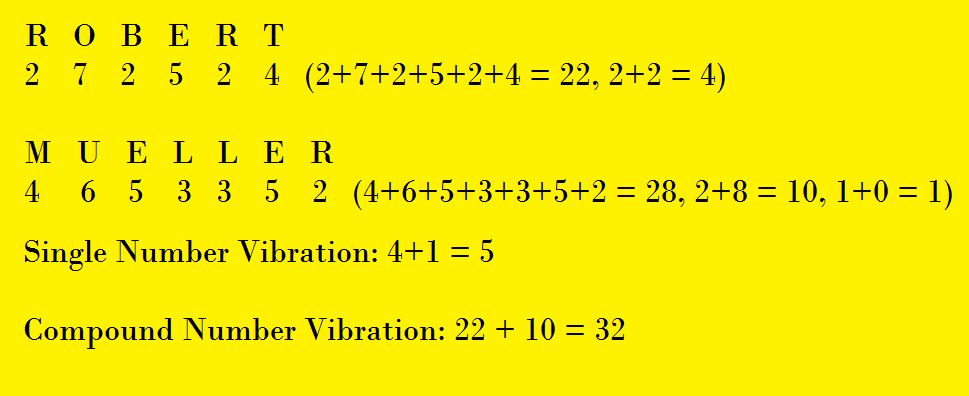
For those unfamiliar, in both systems the numeric vibration of words and names are derived by adding up the assigned values of each letter and then adding together the numbers in the result until a single number is reached. Take this example using the name Robert Mueller:
So, taking what we’ve learned by adding the value of letters in the Special Counsel’s name, we arrive at a vibration of 5 and a compound vibration of 32, the meanings of which I’ve illustrated below:
Now this of course gives us a great deal of insight into Robert Mueller, but the vibration of the numbers in his birth date would be needed to attain a complete picture. Mueller’s birthday is 08/07/1944 which adds up to a compound number of 24 and a single vibration of 6, which means Mueller is a 5 by his name and a 6 by his birth date.
Notice that his birth year, 1944, adds up to 18 (1+9+4+4) and further reduces to 9, which is the primary focus of this article. If you need proof that 9 holds special significance as the ancient Chaldeans believed, simply observe the fact that no other number can reflect the vibration of another number added to it the way 9 does. For example:
3 + 9 = 12, 1+2 = 3 again
8 + 9 = 17, 1+7 = 8 again
It works this way with every number added to 9, including of course 9 itself. The only number more mysterious and powerful is 0, which also has no letter assignment but which further has no word or name vibration assignment by itself at all. Nothing is a zero vibration, but zero plays an important role in compound number vibrations up to 50 (and of course multiplies the mathematical power of any number it follows, e.g. 10, 100, 1000, 10,000, etc.).
For a more in-depth look at Chaldean numerology, please check out my book Understanding Chaldean Numerologyavailable at Amazon on January 6, 2019.
Start learning for free today with the How To Make Money class and the amazing selection of other live and on air classes from CreativeLive.
You will learn creative skills from the world’s top experts – Pulitzer Prize, Grammy, Oscar Winners, and New York Times best selling authors, thought leaders, and legendary entrepreneurs. With over 1,500 curated classes in Photography & Video, Money & Life, Craft & Maker, Art & Design, and Music & Audio, there is something for everyone. Students can watch on-air broadcasts for free or buy a class and own the content for life.
Plus, students can get their daily creative fix on the iOS app with 1 free lesson of their choice, each and every day. I’ve included some upcoming classes below for you to peruse. Give yourself or someone else a holiday gift with this great way to learn!
(Edawlatry is being compensated for this endorsement)




 Edawlatry